Posts

Indian Health and Safety Legislation: Safety Officer Requirement.

Image
Industrial Health and Safety blogs. What are the Indian Health and Safety Legislation Requirement for  "Safety Officer"  in different states? Ans: Section 40-B. Safety Officers According to The Factories Act 1948 In every factory :- wherein  one thousand(1000) or more workers are ordinarily employed , or wherein, in the  opinion of the State Government , any manufacturing process or operation is carried on, which  process or operation involves any risk of bodily injury ,  poisoning or disease or any other hazard to health, to the person employed in the factory , the occupier shall, if so required by the State Government by notification in Official Gazette, employ such number of Safety Officers as may be specified in that notification. UTTAR PRADESH FACTORY RULES 1950 and Uttar Pradesh Factories (Safety Officers) Rules, 1984 THE TAMILNADU ...
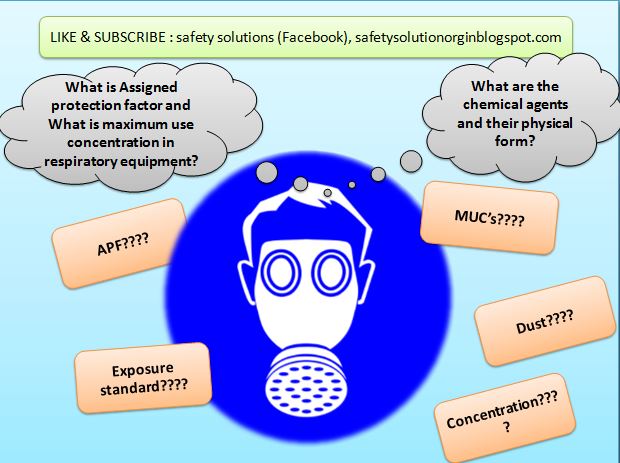
What is Assigned Protection factor in respiratory equipment? How many types of APF from different respiratory equipment? What is maximum use concentration (MUC’s)?

Image
What is Assigned Protection factor in respiratory equipment? How many types of APF from different respiratory equipment? What is maximum use concentration (MUC’s)? < APF helps in selection of right respiratory equipment at workplace. We need two things permissible exposure limit and workplace concentration. Divide workplace concentration by exposure limit, result will decide the required minimum APF. Example: Exposure limit Permissible Exposure Limit (PEL) for asbestos is 0.1 fiber per cubic centimeter of air as an eight-hour time-weighted average (TWA), with an excursion limit (EL) of 1.0 asbestos fibers per cubic centimeter over a 30-minute period. The employer must ensure that no one is exposed above these limits. Workplace concentration Asbestos is 0.5 fiber per cubic centimeter of air as an eight-hour time-weighted average (TWA) Assigned Protection Factor of Respiratory =    0.2/0.1         ...

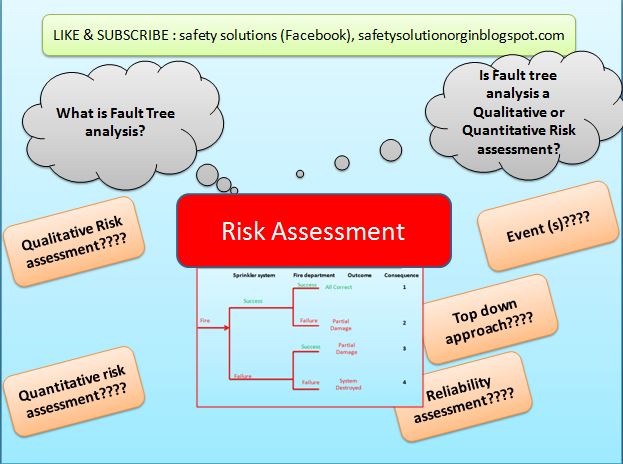
What is Fault Tree analysis in Health and Safety? Is Fault tree analysis a Qualitative or Quantitative Risk assessment?

Image
What is Fault Tree analysis in Health and Safety? Is Fault tree analysis a Qualitative or Quantitative Risk assessment? Risk assessment is of two type .i.e. Quantitative and Qualitative. Quantitative risk assessment means prioritizing the risk through its quantification. Like in 5 X 5 risk assessment matrix, risk prioritized on the basis of Severity and Probability. We multiply both severity and probability and higher the number higher the risk. This ranking or numbering gives us an idea about dealing the high number risk prior to low number risk. This is called as Quantitative risk assessment and Fault tree analysis is one of the quantitative risk assessment techniques as well as qualitative too. Qualitative risk assessment means no quantity and hazard, risk identified from the activity. After identification of hazard and risk we apply control. There is no priority, no ranking. This is called as qualitative risk assessment. Example of qualitative risk assessment is Job safety ...

What is Event Tree analysis in Health and Safety? Is Event tree analysis a Qualitative or Quantitative Risk assessment?

Image
What is Event Tree analysis in Health and Safety? Is Event tree analysis a Qualitative or Quantitative Risk assessment? Risk assessment is of two type .i.e. Quantitative and Qualitative. Quantitative risk assessment means prioritizing the risk through its quantification. Like in 5 X 5 risk assessment matrix, risk prioritized on the basis of Severity and Probability. We multiply both severity and probability and higher the number higher the risk. This ranking or numbering gives us an idea about dealing the high number risk prior to low number risk. This is called as Quantitative risk assessment and Event tree analysis is one of the quantitative risk assessment techniques. Qualitative risk assessment means no quantity and hazard, risk identified from the activity. After identification of hazard and risk we apply control. There is no priority, no ranking. This is called as qualitative risk assessment. Example of qualitative risk assessment is Job safety analysis (JSA). ...

What is Safety culture and what are the methods to improve safety culture at workplace?

Image
What is Safety culture and what are the methods to improve safety culture at workplace? Safety culture  is the attitude, beliefs, perceptions and values that employees adhere, perform or reflect in relation to  safety  in the workplace.  Safety culture  is an integral part of organizational culture. In nut shell it is a way of life for every employee at workplace. In case way of life is positive it is termed as positive safety culture and in case it is negative it is termed as Negative health and safety culture. This can be easily judge by way an employee work at workplace.  Examples given below can be judgmental in analyzing Safety culture at workplace: 1-      An employee working with all Personal protective equipments required for the job, following all SOP’s for the job, doing the work which is for he is authorized, commencing the job after appropriate tool box talk following hazard identification risk a...

What are the steps involved in investigating an Accident? Do you know the types of incident investigation techniques?

Image
What are the steps involved in investigating an Accident? Do you know the types of incident investigation techniques? Investigation of the incidents done by organisation to ascertain the root causes so as to prevent recurrence. If investigation not done religiously and done for the sake of paper work then recurrence of the incidents is probable.   Prime reason for doing accident investigation is to ascertain the root cause, eliminate the root cause or apply hierarchy of controls in the form of corrective and preventive actions to prevent recurrence in future. Accident investigation points out the actual gap in the ideal practice of managing health and safety (What went wrong). This helps management to correct the gap and prevent accident in future. Accident investigation motivates workforce that management is keen to prevent accident at workplace and in case when accident investigation clear cut protocol is being followed then this motivation increases exponential...

What are the key changes in ISO 14001? What is context of the organization under ISO 14001? What is LCA ? Is it mandatory requirement?

Image
Key Changes in ISO 14001 ISO 14001 was revised in September 2015 and there are many changes. Key changes including harmonization of elements with ISO 9001:2015 so as to integrate managements system conveniently and effectively within the organisation. The new ISO 14001 standards are grouped around five key areas: leadership, strategic context, interested party analysis and communication, risks and opportunities and life cycle perspective. D8Ghptogzps/Whgu2P0KkrI/AAAAAAAAB40/xVB8QRVklroOYQvuZ0XX39rt_hdPwFtMwCEwYBhgL/s1600/ISO%2B14001%2Bchanges.JPG" imageanchor="1" style="margin-left: 1em; margin-right: 1em;"> Few key changes are as below: 1-       Clause 4.0 -Context of the organisation: While developing scopes and objectives of the organisation for EMS (Environmental management system) due consideration should be done for internal & external stakeholders and associated influencing elements. It means organization has to consider...

Do you know what is Asbestosis?Do you know what is Miners’ Nystagmus?Do you know what is Siderosis?Do you know what is Muscoloskeletal Disorder?

Image
Do you know what is Asbestosis?Do you know what is Miners’ Nystagmus?Do you know what is Siderosis?Do you know what is Muscoloskeletal Disorder? Occupational diseases means diseases developed in worker during course of workplace activities.  Reasons are variable as diseases are variable due to different sources. Asbestosis happened due to asbestos, Nystagmus which is also called as dancing eye, Siderosis is the deposition of the iron in the tissue, Musculoskeletal Disorders or MSDs are injuries and disorders that affect the human body's movement or musculoskeletal system (i.e. muscles, tendons, ligaments, nerves, discs, blood vessels, etc.). Common MSDs include: Carpa l Tunnel Syndrome. Tendonitis. Muscle / Tendon strain, Occupational cancer is cancer caused by occupational hazards. Several cancers have been directly tied to occupational hazards, including chimney sweeps' carcinoma, mesothelioma, and others. Disease happened to an individual due to smoking...

Popular posts from this blog

What are the reasons for managing Health and Safety?

What is the difference between Health and Safety Audit and Inspection?

What is Safety culture and what are the methods to improve safety culture at workplace?

What is Violation? What are the types of violation? Mention few examples of types of violations?

Indian Health and Safety Legislation: Safety Officer Requirement.