Posts

Showing posts with the label Negligent act

Indian Health and Safety Legislation: Safety Officer Requirement.

Image
Industrial Health and Safety blogs. What are the Indian Health and Safety Legislation Requirement for  "Safety Officer"  in different states? Ans: Section 40-B. Safety Officers According to The Factories Act 1948 In every factory :- wherein  one thousand(1000) or more workers are ordinarily employed , or wherein, in the  opinion of the State Government , any manufacturing process or operation is carried on, which  process or operation involves any risk of bodily injury ,  poisoning or disease or any other hazard to health, to the person employed in the factory , the occupier shall, if so required by the State Government by notification in Official Gazette, employ such number of Safety Officers as may be specified in that notification. UTTAR PRADESH FACTORY RULES 1950 and Uttar Pradesh Factories (Safety Officers) Rules, 1984 THE TAMILNADU ...

What are RNOAD 1996 and RIDDOR 2013 for recording and reporting accident/incident or disease?

Image
What are the government/ global agencies enforcement initiatives on organisations for reporting an accident/incident? What are RNOAD 1996 and RIDDOR 2013? Duty of Care should be exercise at workplace by both Employee and their Organisation. Employee should obey the norms developed and implemented for health and safety. Similarly organisation should provide explicitness / clear cut health and safety procedures, training on these procedures, review for any gaps in the implementation, review to update the procedure and records keeping. Consultation and communication of procedure before and after development is necessary. Similarly need arise for recording, reporting and investigation of an accident/ incident/ disease happened at workplace while doing business by Organsiation to show duty of care, legally compliant etc. Employee should be aware for; in case any reportable accident/incident/ disease (Dangerous occurrence/ fatal/lost time injury) occurred during business then who wil...

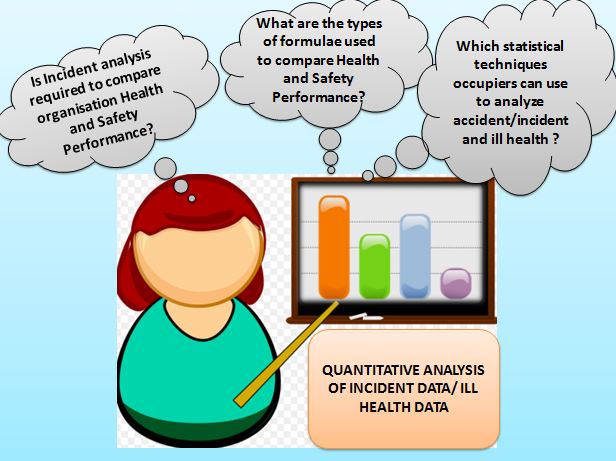
What are the types of formulae used to compare Health and Safety Performance? Which statistical techniques occupiers can use to analyze accident/incident and ill health? Is Incident analysis required to compare organisation Health and Safety Performance?

Image
What are the types of formula used to compare Health and Safety Performance? Which statistical techniques occupiers can use to analyze accident/incident and ill health?  Is Incident analysis required to compare organisation Health and Safety Performance? You cannot manage, what you cannot measure (.i.e. Peter F Drucker). So measuring health and safety performance is vital for any organisation, country so as to take decisions for further improvements and find the gaps in the existing efforts. Measuring health and safety performance should be quantitative wherever possible. This can be made easy with the help of different formula used by countries like US and UK (HSE and OSHA) to compare health and safety performance. Types of formula used to compare health and safety performance differ from country to country.  However below mentioned formula are common while doing comparison of health and safety performance among country, organisation, states, within ...

What is Violation? What are the types of violation? Mention few examples of types of violations?

Image
What is Violation? What are the types of violation? Mention few examples of types of violations? Violation defined as willful act which is against the rules, norms, standard etc. done by individual worker to complete the task like maintenance, inspection, driving etc. Sometimes these type of violation lead to incident at workplace. Individual involved in the violation injured himself and sometime his act injured others. Violations usually done to complete the task assigned to worker in convenient manner. Maximum time violation done to complete the productivity task . Violations found very common among those who are local residents to the plant premises in comparison to those who are living far from the plant premises. Also violation done by workers as they are not aware of the consequence and they are unaware about the benefits of doing job safely. Violation can be reduced considerably by the way of imparting awareness about health and safety significance, sharing about the con...

What is Human error in accident? What are the types of failure? How accident at workplace happened due to human error?

Image
What is Human error in accident? What are the types of failure? How accident at workplace happened due to human error? Human error means deviation from set of prescribed actions intended to perform by the worker at workplace for his job results into accident/ incident. Human error can be related with the human behavior. Identification of human error, corrective and preventive actions for mitigating human error can help to reduce the accident / incident at workplace. There are broadly two types of failures .i.e. Active and Latent. Active failures mean failures done by individual worker or operator . These types of failures are direct cause of the accident/ incident and consequence can be seen immediately after the failure. Few examples are as below: Incorrect selection of tools, Wrong switch operated, Over speeding, Fail to isolate the equipment at workplace during maintenance job lead to accident/ incident. ...

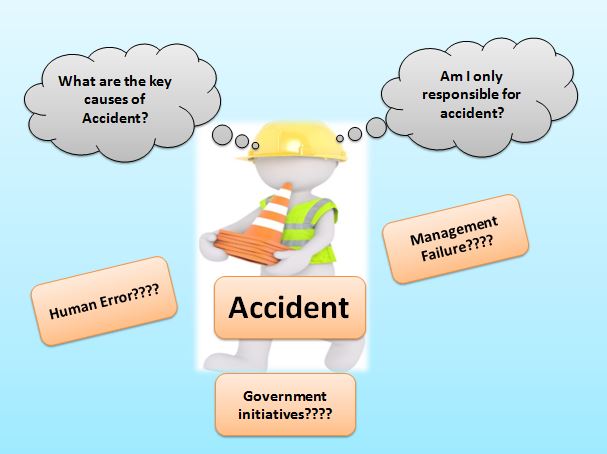
What are the key causes of Accident? Who are responsible for preventing accident at workplace?

Image
What are the key causes of Accident? Who are responsible for preventing accident at workplace? Three key categories are important when we are talking about causes of accident. First cause is Human error, second management failure and third one is lack of Government initiatives. These all three are responsible for preventing accident. Their roles are different however depend on each other. Human error usually understands as a fault of an individual and accident considers to be happened due to his negligence. However this is not the correct answer. Human error can be due to poor ergonomics, due to fatigue at the job etc. Poor ergonomics means poor workstation design or improper good fit between individual and his workplace. Fatigue can be reduced by job rotation, automation of the job, workplace design sometimes also helps in reducing the fatigue. Many examples are present which directly indicates accident happening due to human failure. Some examples are Bhopal Gas Trag...

What are the reasons for managing Health and Safety?

Image
Equally important three reasons are behind managing health and safety at workplace. These are as below: 1  -         Moral, 2  -        Financial and 3  -       Legal reasons Moral reasons: Every individual has right to work in safe workplace while performing his assigned task. He comes to a workplace in happy mode and expects to return in a same manner. Same time individual has a duty to follow all health and safety norms so as to save him as well as prevent injury to others by his acts. Here come two things “Duty of Care” and “Negligent act”. Duty of care is an obligation to exercise a level of care towards an individual that is reasonable in all circumstances to avoid injury to that individual and to his belongings. Negligent act is not intentionally but careless act which results into loss. Only Negligent act is regarded as a breach of “duty of care...

Popular posts from this blog

What are the reasons for managing Health and Safety?

What is the difference between Health and Safety Audit and Inspection?

What is Safety culture and what are the methods to improve safety culture at workplace?

What is Violation? What are the types of violation? Mention few examples of types of violations?

Indian Health and Safety Legislation: Safety Officer Requirement.